
Choosing the best China Non Touch Faucets requires more than comparing catalog prices. Global buyers need reliable performance, clear specifications, and suppliers who understand different commercial environments. A faucet that works well in a hotel lobby may not suit a busy airport restroom or a healthcare facility.
This guide examines practical details that influence purchasing decisions. These include infrared sensor accuracy, water flow control, response time, battery or electrical power, finish quality, and maintenance access. We also consider brass or stainless-steel construction, cartridge durability, packaging protection, and replacement parts. In real projects, small details matter. A difficult battery compartment can increase service time. Poor sensor positioning may cause false activation beside a washbasin. These problems are easy to overlook in product photos.
Reliable sourcing also depends on supplier evaluation. Buyers should review factory experience, quality-control procedures, testing records, and export support. Relevant product certifications may be necessary, depending on the destination market and installation environment. Requirements can vary widely. Confirm them independently before placing an order. Factory audits, sample testing, and written inspection standards provide stronger evidence than sales promises alone.
No single model is perfect. A low-cost faucet may offer attractive margins but require more frequent maintenance. A premium model may provide better materials, yet its spare parts could be expensive or difficult to obtain. This guide compares those trade-offs for distributors, contractors, hospitality groups, and facility managers. The goal is practical judgment, not exaggerated claims. Buyers can then choose Non Touch Faucets with greater confidence and fewer costly surprises.
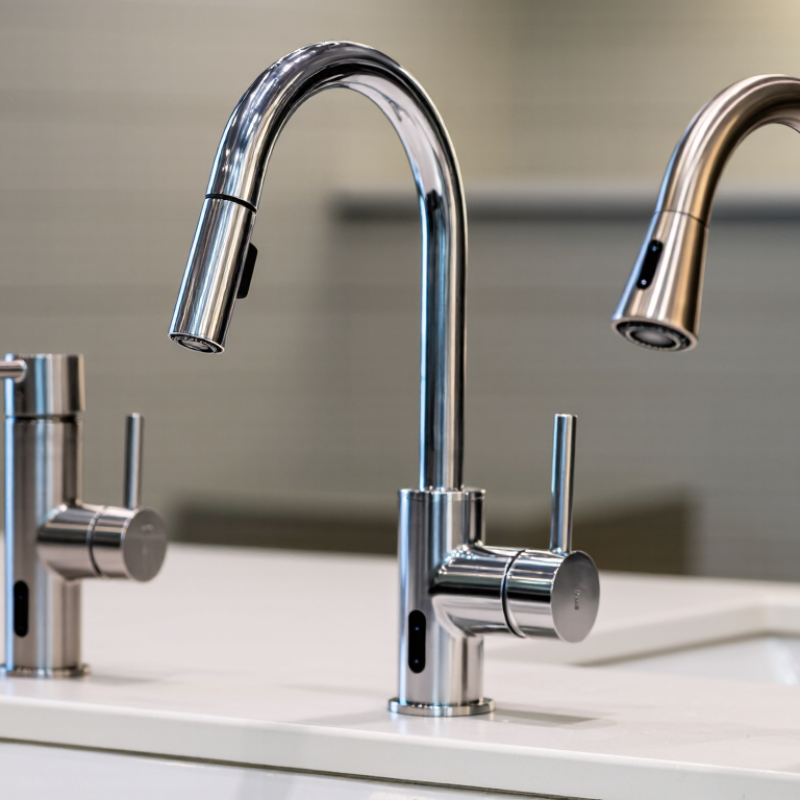
A non-touch faucet uses a sensor to detect hand movement without a handle. Most models use infrared light, while a few use other proximity technologies. When hands enter the sensing range, the sensor sends a signal to a solenoid valve. The valve opens, allowing water to flow through the spout. When hands move away, the valve closes automatically.
This design reduces contact with the faucet surface. It can support better hygiene in bathrooms, kitchens, healthcare spaces, and commercial buildings. Many units use batteries, low-voltage adapters, or both. Buyers should check battery life, sensor distance, flow rate, inlet size, and the availability of replacement parts. A useful installation test is simple: place a hand beneath the spout, then remove it slowly. Water should start and stop without noticeable delay.
The technology is practical, but not flawless. Bright sunlight, reflective sinks, dirt on the sensor window, or incorrect positioning may affect detection. Water pressure also influences performance. A professional installer should flush the pipes before connection and inspect every joint for leaks. From a buyer’s perspective, service access matters as much as appearance. A sleek faucet is less useful when its valve cannot be reached. I would also question unusually low prices, because hidden costs may appear in sensors, cartridges, or shipping. Small details often decide long-term reliability.
| Evaluation Dimension | Typical Specification or Fact | Why It Matters to Global Buyers | Recommended Buying Check |
|---|---|---|---|
| Operating Principle | An infrared or time-of-flight sensor detects the user’s hands and sends a signal to an electronic solenoid valve. | Water starts and stops without touching the handle, helping reduce contact with shared surfaces. | Confirm the sensor type, detection logic, and whether the valve closes automatically when hands leave the sensing zone. |
| Sensor Detection Distance | Common adjustable working ranges are approximately 5–20 cm, depending on the sensor design and installation environment. | The correct range helps prevent false activation while keeping operation convenient. | Request the tested range after installation, not only the maximum laboratory distance. |
| Activation Response | Electronic sensor faucets commonly activate within about 0.5–1 second when hands enter the detection zone. | Fast response improves user comfort and reduces repeated hand movements. | Ask for response-time test results using the intended basin, water pressure, and power supply. |
| Automatic Shut-Off | The valve normally closes when the user leaves the sensing field; many designs also include a maximum run-time safety cut-off. | Automatic shut-off can limit water waste and reduce the risk of an unattended flow. | Verify the maximum continuous-flow duration and whether it can be adjusted for the project. |
| Power Options | Typical configurations use batteries, low-voltage mains power, or a hybrid battery-and-mains arrangement. | Power availability, maintenance access, and local electrical requirements differ by country and building type. | Confirm input voltage, battery type, expected battery life, cable length, and backup behavior during power failure. |
| Water Flow Rate | Basin sensor faucets commonly use aerated or flow-restricted outlets in the approximate range of 1.9–5.7 L/min, depending on the model and market requirement. | Lower flow can reduce water consumption, while higher flow may improve rinsing speed. | Check the flow rate at the intended pressure and confirm whether the outlet meets the destination market’s water-efficiency rules. |
| Recommended Water Pressure | Many commercial sensor faucets are designed for approximately 0.05–0.8 MPa, but the exact operating range varies by valve and aerator. | Insufficient pressure may reduce flow, while excessive pressure can cause noise, leakage, or component stress. | Match the product’s pressure range with the building’s static and dynamic water-pressure readings. |
| Temperature Control | Options include cold-water-only models, integrated temperature mixing, or an external thermostatic mixing valve. | The choice affects installation complexity, user safety, and compatibility with hot-water systems. | Confirm the hot and cold inlet arrangement, maximum permitted temperature, and anti-scald protection. |
| Installation Type | Common formats include deck-mounted basin faucets, wall-mounted units, and countertop-mounted commercial designs. | Mounting dimensions determine whether the faucet fits the basin, countertop, wall preparation, and plumbing layout. | Request the mounting-hole diameter, spout reach, spout height, connection size, and technical drawing. |
| Material Selection | Common body materials include brass, stainless steel, and engineered metal alloys; external finishes may include chrome, brushed, or powder-coated surfaces. | Material and finish influence corrosion resistance, appearance, durability, and cleaning requirements. | Ask for the material grade, coating process, salt-spray or corrosion-test evidence, and potable-water contact documentation where applicable. |
| Hygiene and Cleaning | Touch-free operation reduces direct hand contact, but the outlet, basin, and surrounding surfaces still require routine cleaning. | No-touch activation supports hygiene goals but does not replace cleaning or water-system maintenance. | Prefer smooth, easy-to-clean surfaces and confirm compatibility with the cleaning chemicals used at the site. |
| Protection Against Water and Dust | Sensor and control housings may carry an IP rating, but the rating applies only to the tested enclosure and installation conditions. | A suitable enclosure helps protect electronic components in humid washroom environments. | Request the complete IP test report and confirm that cable joints, battery compartments, and control boxes are also protected. |
| Relevant Compliance Areas | Depending on the destination, buyers may need plumbing-product, potable-water-contact, electrical-safety, electromagnetic-compatibility, or accessibility compliance. | Compliance requirements can affect customs clearance, project approval, insurance, and installation acceptance. | Identify the destination-country requirements before ordering and request current certificates and test reports for the exact model. |
| Maintenance Parts | Typical service items include batteries, solenoid valves, filters, aerators, seals, sensor modules, and mixing-valve components. | Replaceable parts can reduce downtime and total ownership cost in commercial installations. | Confirm spare-part availability, replacement instructions, warranty terms, and the expected support period. |
| Best Application | Suitable applications include public washrooms, hospitality, healthcare, offices, transport facilities, schools, and residential bathrooms. | The correct configuration depends on traffic level, water quality, vandal-resistance needs, temperature control, and maintenance access. | Select the design according to usage frequency, installation environment, local standards, and lifecycle-cost objectives rather than appearance alone. |
The best non-touch faucets begin with reliable sensing, not flashy appearance. A stable infrared sensor should detect hands from different angles and respond within a second. Adjustable sensing distance is valuable in busy washrooms. It reduces false activation near sinks, walls, or reflective surfaces. Test this feature with wet hands, gloves, and low-light conditions before placing a large order.
Material choice also matters. Lead-free brass or certified stainless steel supports safer water contact and longer service life. A ceramic cartridge should control temperature smoothly, while a replaceable aerator can limit splashing. Look for an IP-rated sensor housing, sealed wiring, and a durable solenoid valve. These details protect the faucet from moisture, dust, and frequent daily use. They sound minor. They are not.
Power design separates convenient products from troublesome ones. Battery models need clear low-power warnings and simple access for replacement. Adapter-powered models should support the destination market’s voltage and plug requirements. Ask for test reports, installation drawings, spare parts, and sample units. Independent inspections can confirm flow rate, sensor response, leakage resistance, and surface quality. I have seen attractive samples fail after repeated cycles. One lesson remains: a smooth showroom demonstration proves very little. Even excellent faucets may need adjustment for local water pressure, installation habits, and maintenance skills.
Global buyers should compare Chinese faucet suppliers through evidence, not catalog appearance. Request factory registration, export history, quality certificates, and recent inspection records. ISO’s 2023 Survey reported over one million ISO 9001 certificates worldwide, but certification alone cannot prove consistent faucet performance. Ask for the certificate scope, issuing body, and audited production address.
Technical comparison should cover sensor response, flow rate, leakage resistance, finish durability, and spare-part availability. Request samples from regular production, not specially prepared units. Test them with different water pressures and repeated hand movements. A laboratory report should identify test methods and sample numbers. Relevant requirements may include EN, ASME, NSF, or local plumbing standards. Requirements vary by destination.
Supply-chain evidence also matters. The World Bank’s Logistics Performance Index 2023 placed China 19th, with a score of 3.7 out of 5. This suggests strong logistics capability, but it does not remove port, packaging, or communication risks. Compare lead times using written production milestones. Check carton drop tests and moisture protection. Cheap is not always cheap.
I would also compare warranty handling, software support, and replacement sensor costs. A low quotation can conceal tooling fees or fragile components. One weakness in my own early comparisons was overvaluing unit price. A better review weighs landed cost, test evidence, corrective-action speed, and long-term service. Manufacturers that welcome independent inspections usually provide stronger evidence of operational maturity.
Global buyers can compare Chinese faucet suppliers with a 100-point procurement framework. Compliance and documentation receive the highest weight because international certifications, test reports, material declarations, and installation requirements directly affect import approval and project risk. Sensor performance, quality control, delivery capability, customization, and after-sales support should also be evaluated before sampling and contract approval. The weighting is a practical buyer benchmark, not company or brand performance data.
For global buyers, a non-touch faucet needs more than a polished surface and quick sensor response. In real procurement reviews, certification documents often reveal the product’s true export readiness. Ask for the exact model number, factory address, test laboratory, issue date, and certificate scope. A certificate without matching model details is a warning sign.
For drinking-water contact parts, verify NSF/ANSI/CAN 61 or an equivalent national standard. ASME A112.18.1/CSA B125.1 can support plumbing performance and durability claims. Electronic models may also require EMC, electrical safety, and low-voltage testing under the destination market’s rules. RoHS documentation matters for restricted substances, but it does not prove water safety. These requirements are different. Do not treat them as interchangeable.
The WHO and UNICEF Joint Monitoring Programme reported that 2.2 billion people lacked safely managed drinking water in 2022. That figure makes material safety and hygiene more than marketing language. Buyers should request lead, nickel, microbial, flow-rate, leak, and endurance test results. For water-saving claims, compare measured flow with local requirements, such as WaterSense or WELS criteria. Also inspect IP ratings for sensor housings and battery compartments. A higher rating is not automatically better. It may still fail after poor installation. Factory audits, sample testing, and independent laboratory verification remain useful, although they add time and cost. Some suppliers provide impressive files, but incomplete renewal records can quietly undermine an otherwise credible quotation.
Price should be compared line by line, not by unit cost alone. Ask whether the quote includes sensors, batteries, valves, packaging, and testing. Confirm the trade term, payment schedule, minimum order quantity, and spare-parts allowance. A low quote can still be expensive. I once focused too heavily on the faucet price and overlooked custom packaging charges.
Customization needs written boundaries. Confirm finish samples, sensor range, water-flow settings, logo placement, and carton markings before production. Request a pre-production sample with the exact controller and power setup. Small details matter. Check whether software settings, manuals, and labels support your market. Avoid accepting “customizable” without drawings, approval steps, and change-control rules.
Shipping performance depends on preparation. Ask for production lead time, inspection timing, carton dimensions, and loading photos. Compare sea, rail, and air options using landed cost, not freight alone. A professional supplier should provide stable export documents and clear packing information. After-sales support deserves equal attention. Request a warranty period, troubleshooting guide, response-time target, and replacement-part list. Test how quickly the sales team answers difficult questions. Slow replies before payment may become slower after delivery. Keep every promise in the contract, because verbal assurances are easy to forget.

Sign up for our mailing list to stay informed and up to date with our latest news and products!
(905) 832 – 0600
2175-A Teston Road
Maple, Ontario
L6A 1T3
(780) 451 – 0238
24790 – 117 Avenue
Acheson, Alberta
T7X 6C2
(604) 882 – 1564
9511 – 194A Street
Surrey, British Columbia
V4N 4G4
(306) 955 – 6005
3926 Arthur Rose Avenue Saskatoon, Saskatchewan
S7P 0C9
(450) 687 – 2721
2750 Rue Bernard-Lefebvre
Laval, Quebec
H7C 0A5