
How to Choose the Right Nitrile O Rings for Your Application

Choosing the right Nitrile O Rings begins with understanding the application, not simply matching a size. Temperature, pressure, fluid type, movement, and installation conditions all influence sealing performance. A ring that works perfectly in a hydraulic pump may fail quickly in a fuel system or exposed outdoor assembly.

Dr. Robert Flitney, a respected sealing engineer and author of the Seals and Sealing Handbook, states, “The function of a seal is to prevent leakage of a fluid.” That simple principle deserves careful attention. Nitrile O Rings are valued for their resistance to petroleum-based oils, fuels, and hydraulic fluids. However, standard nitrile compounds are not suitable for every environment. Excessive heat, ozone, sunlight, or aggressive chemicals can cause swelling, hardening, cracking, or permanent deformation.

This guide examines how to choose Nitrile O Rings by reviewing compound grades, hardness, temperature limits, pressure exposure, and dimensional accuracy. It also considers practical details, such as a scratched groove, twisted installation, or insufficient lubrication. Small mistakes matter.

Experience often reveals what a specification sheet misses. A seal may look correct on the workbench but fail after repeated compression and vibration. That is why material compatibility should be verified with current supplier data and, when possible, tested under real operating conditions. No selection chart replaces engineering judgment. Even experts sometimes overlook installation quality. Careful inspection remains essential.
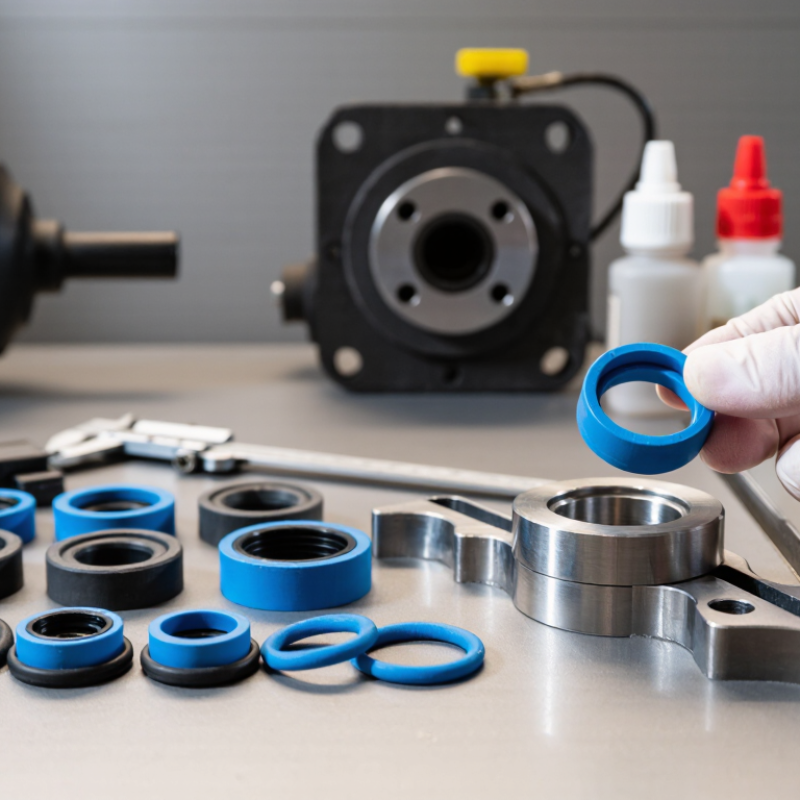
How to Choose the Right Nitrile O Rings for Your Application

Define Nitrile O-Ring Grades by 18–50% Acrylonitrile Content

Choosing the right nitrile O-ring starts with acrylonitrile content, usually ranging from 18% to 50%. ISO 1629 and ASTM D1418 identify nitrile rubber as NBR. Engineering data based on ASTM D2000 commonly place general NBR service near -40°C to 108°C, depending on formulation. Lower acrylonitrile grades, around 18–24%, remain more flexible in cold conditions. They suit outdoor equipment, pneumatic seals, and low-temperature movement. Their oil and fuel resistance is weaker, however.

Grades near 25–35% offer a practical balance for hydraulic equipment, pumps, and engine housings. They tolerate mineral oils while retaining moderate flexibility. Higher grades, around 36–50%, usually provide stronger resistance to petroleum fluids, swelling, and permeation. A 2023 fuel-system materials review from the U.S. Department of Energy reports that fuel compatibility depends on both polymer composition and exposure conditions. Temperature, pressure, fluid additives, and compression all matter.

Do not choose by percentage alone. A 45% grade may resist fuel well but lose elasticity in a cold warehouse. I have seen installation failures caused by a correct compound and the wrong groove size. Hardness also changes sealing behavior. ASTM D2000 test results help compare tensile strength, elongation, hardness, and heat aging, but they do not reproduce every field condition. Test the actual fluid, temperature cycle, and surface finish when failure would be costly.


Match Operating Temperatures from −40°C to 120°C with NBR Limits

How to Choose the Right Nitrile O Rings for Your Application

Nitrile rubber, or NBR, can cover approximately −40°C to 120°C in selected formulations. This range is not universal. According to ASTM D2000 material testing requirements, heat aging, compression set, and fluid resistance must be evaluated before approval. A seal surviving 120°C air may fail sooner in hot oil, fuel, or pressurized gas.

Check the actual temperature cycle, not only the maximum reading. For example, an O ring exposed to 110°C oil during a twelve-hour shift needs different consideration than one seeing 120°C for ten minutes. ASTM D471 immersion testing measures volume and hardness changes after fluid exposure. These results help reveal swelling, shrinkage, or stiffening. ISO 3601 also supports controlled O-ring sizing and inspection, but it does not make every NBR compound suitable for the full temperature range.

Higher acrylonitrile content often improves oil resistance, but it can reduce low-temperature flexibility. That trade-off matters near −40°C. A seal may look perfect on the workbench, then leak after overnight cooling. I have seen selection errors caused by trusting catalog limits without checking pressure, surface finish, and compression. Request compound-specific test data, including compression set after heat aging. Leave margin where possible. The published limit is a boundary, not a comfort zone.

How to Choose the Right Nitrile O-Rings for Your Application

Temperature is a primary selection factor for O-rings. Typical continuous service limits vary by compound and formulation, but standard NBR is commonly used from approximately −40°C to 100°C, while selected high-temperature NBR compounds can reach about 120°C. Always confirm the compound-specific limits, pressure, fluid compatibility, and exposure time before final selection.

Select 40–90 Shore A Hardness for Pressure, Gap, and Sealing Needs

How to Choose the Right Nitrile O Rings for Your Application

Select 40–90 Shore A Hardness for Pressure, Gap, and Sealing Needs

Nitrile O rings usually cover 40–90 Shore A, but hardness alone does not define sealing success. A 70 Shore A compound often suits general hydraulic and pneumatic service. Softer 40–60 Shore A rings conform well to rough surfaces and low-pressure joints. They may extrude when pressure rises or clearance becomes wide. Harder 80–90 Shore A rings resist extrusion better, yet they need higher installation force and cleaner surfaces.

Pressure, gap, and temperature must be checked together. Industry guidance based on ISO 3601-1 and ASTM D2000 treats material grade, dimensions, and service conditions as connected choices. ASTM D2240 also shows why measured hardness needs care. Test force, dwell time, and temperature can change the reading. A “70 Shore A” label is not a complete performance guarantee. In field work, a small clearance error can matter more than a five-point hardness difference. That is easy to miss.

Tips: Start near 70 Shore A for ordinary sealing, then adjust. Choose 40–60 Shore A for surface conformity and lower pressure. Select 80–90 Shore A where extrusion risk is serious. Check the manufacturer’s pressure-gap chart, not memory. Measure the groove and shaft directly. A harder ring can still leak if the groove is too deep, the seal twists, or compression is uneven. Validate one sample under real pressure, temperature, fluid exposure, and cycling conditions before approving production.

Verify Chemical Compatibility Using ASTM D471 Volume-Swell Data

How to Choose the Right Nitrile O Rings for Your Application

Verify Chemical Compatibility Using ASTM D471 Volume-Swell Data

Chemical compatibility should begin with measured volume change, not a generic “oil resistant” label. ASTM D471 evaluates elastomer changes after controlled liquid immersion. ISO 1817 uses a comparable approach. Test reports commonly show nitrile compounds swelling about 5–25% in petroleum-based fluids, depending on acrylonitrile content, temperature, and formulation. Higher swelling can soften the seal and reduce squeeze retention.

Look for the exact test fluid, temperature, exposure time, and hardness change. A report showing 18% volume swell at 100°C may be acceptable for a static seal, but risky in a moving application. ASTM D471 does not create one universal pass limit. The equipment designer must define it. That part is often missed.

Field reviews also reveal a practical mistake: engineers compare fluid names but ignore additives. A hydraulic fluid with the same base oil can produce different results after aging. Ask for test data using the finished fluid, not only a standard reference oil. Published laboratory reports often include mass change, volume change, tensile strength, and elongation. Review all four.

Check compression set separately.

One result is never enough.

A useful selection record should link the O-ring compound, batch data, fluid specification, and ASTM D471 conditions. If the report lacks those details, treat its conclusion cautiously. Retesting after thermal cycling may expose weaknesses that a short immersion test misses.

Specify AS568 or ISO 3601 Sizes and Validate Compression Set Performance

Choosing a nitrile O-ring starts with a precise size specification. AS568 uses inch-based dash numbers, while ISO 3601 identifies metric dimensions. These systems are not interchangeable by appearance alone. A small difference in cross-section can reduce sealing force and increase leakage risk.

AS568 and ISO 3601 sizing tables provide the nominal inside diameter and cross-section. Confirm both values before ordering. Then check gland fill, stretch, and clearance against the assembly drawing. A practical starting point is about 15–30% squeeze for many static seals, but temperature, pressure, and groove design can change that range. Standards provide guidance, not permission to guess.

Compression set deserves physical validation. ASTM D395 measures permanent deformation after controlled compression, while ISO 815-1 provides a comparable elastomer test method. Request results at the application temperature, not only at a room-temperature condition. For example, a 30% compression set means the material has retained substantial deformation after unloading. That may cause poor recovery during thermal cycling. Field reviews often reveal this mistake. The certificate looked acceptable.

Test samples in the actual fluid, temperature, and squeeze range. Record initial height, compressed height, recovery time, and final height. Repeat the test after aging when possible. A spreadsheet can still mislead if the test fixture differs from the production gland. Small details matter, especially surface finish and installation stretch.

How to Choose the Right Nitrile O Rings for Your Application - Specify AS568 or ISO 3601 Sizes and Validate Compression Set Performance

Selection Factor Reference Data How to Apply It
Material Nitrile rubber (NBR), also known as acrylonitrile-butadiene rubber. Consider NBR for many petroleum-oil and fuel sealing applications. Confirm compatibility with the exact fluid, additives, temperature, and exposure duration.
Hardness 70 Shore A is a commonly specified general-purpose O-ring hardness; other hardnesses are available. Choose hardness based on pressure, gland design, extrusion gap, assembly method, and the supplier’s available compound data. Hardness alone does not establish chemical compatibility or service life.
Temperature range A commonly cited general range for many NBR compounds is approximately −30°C to +100°C (−22°F to +212°F). Treat this as a screening range, not a guarantee. The usable range depends on the specific compound, fluid, pressure, and exposure time; obtain compound-specific limits before release.
Size standard AS568 designations identify inch-based O-ring sizes. ISO 3601 provides an international O-ring size and tolerance system with metric size designations. State the standard and size designation on the drawing or purchase specification. Do not assume that a nominally similar size from another standard is interchangeable; check inside diameter, cross-section, and applicable tolerances.
AS568 example: dash size −010 Nominal inside diameter: 0.239 in (6.07 mm). Nominal cross-section: 0.070 in (1.78 mm). Use this as a size-reference example only. Verify the required standard, tolerances, groove dimensions, and actual part measurements for the application.
AS568 example: dash size −214 Nominal inside diameter: 1.484 in (37.69 mm). Nominal cross-section: 0.139 in (3.53 mm). Confirm that the selected cross-section suits the gland and that the installed ring has the required stretch and squeeze. Do not select by inside diameter alone.
Groove and squeeze Installed squeeze is determined by the O-ring cross-section and the gland geometry; allowable values depend on whether the seal is static or dynamic and on the design guidance used. Calculate squeeze from the actual gland dimensions and check gland fill, stretch, extrusion clearance, and assembly conditions against a recognized design guide or validated engineering specification.
Compression set test ASTM D395 Method B is a commonly used test method for compression set of rubber materials. Test temperature and duration must be specified. Request test results for the exact compound and agreed test conditions. A result is meaningful only when the method, temperature, duration, specimen, and recovery procedure are identified.
Compression set calculation Compression set (%) = [(original thickness − recovered thickness) ÷ (original thickness − spacer thickness)] × 100. Compare results obtained under the same test conditions. Lower compression set generally indicates better recovery in that test, but does not by itself predict seal life in every service environment.
Application acceptance target Set a project-specific maximum compression-set value, for example ≤25% under an agreed test condition, only when supported by application requirements and compound qualification. Do not treat this example as a universal NBR limit. Validate the proposed acceptance criterion through design review, material data, and testing representative of the intended service.
Final validation Review dimensions, compound identification, hardness, fluid compatibility, temperature, pressure, and compression-set data together. Where failure risk is significant, test production-representative seals in the actual fluid, temperature, pressure, and duty cycle before approving the specification.

Note: Listed dimensions are nominal examples. Confirm current standard requirements and tolerances from the applicable edition of AS568 or ISO 3601, and verify compound-specific properties with test data.

Request Quote

Sign Up