
Choosing a Cleanroom Chiller System is about more than comparing cooling capacity or price. Cleanrooms need stable conditions, often across long operating hours. A small temperature swing can affect humidity control, equipment performance, or sensitive production steps. The chiller must also work well with air-handling units, filters, pumps, and building controls. Details matter.
Cleanroom contamination-control expert William Whyte’s work offers a useful reminder, paraphrased here: “Control the room as a whole, not the chiller alone.” That principle helps frame this look at China’s top 10 cleanroom chiller system manufacturers. The comparison considers system design, temperature-control capability, energy performance, product documentation, installation support, and after-sales service. Buyers should check these points against their actual heat loads and operating conditions. A polished brochure is not proof of performance. Ask for technical data and service details.
No single manufacturer will suit every project. Some facilities need tight temperature stability; others prioritize redundancy, efficient part-load operation, or support for complex controls. Even a strong product can disappoint if commissioning or maintenance is weak. That part is easy to underestimate. The list is a starting point, not a substitute for engineering review. Verify specifications, references, and local service coverage before making a decision.
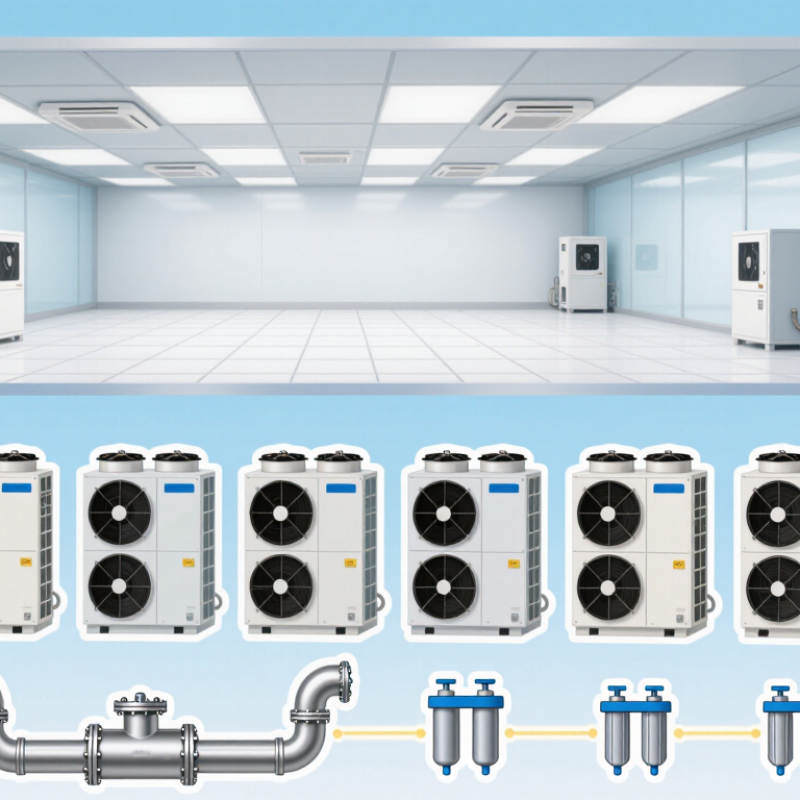
Cleanroom chiller systems remove heat from process equipment, lighting, people, and supply air while helping maintain stable room temperatures. They serve chilled-water coils in air-handling units; those coils cool and, when needed, dehumidify incoming air. The chiller does not control cleanliness by itself. Filters and airflow design do that work. Temperature stability still matters.
Design starts with measured loads, not just floor area. Engineers account for equipment heat, outdoor conditions, humidity targets, and future production changes. Lawrence Berkeley National Laboratory cleanroom energy benchmarking research reports that cleanrooms can use roughly 10 to 100 times more energy per floor area than typical offices, depending on process and cleanliness requirements.
That range is wide, but it highlights why load estimates and efficient controls matter. ASHRAE’s HVAC Applications guidance also emphasizes coordinated air-conditioning design for clean spaces. Redundancy may be appropriate where an interruption risks product quality.
In operation, chilled water circulates through the chiller and cooling coils, absorbing heat before returning warmer to the plant. Operators track supply-water temperature, return-water temperature, flow, and room humidity. Small drift matters. A rising return temperature may signal changing loads or poor heat transfer, but it is not a diagnosis on its own. Trend data and coil inspections help teams distinguish control problems from maintenance needs. Real systems are rarely as tidy as the design model.
Choosing a cleanroom chiller manufacturer in China requires more than comparing cooling capacity and price. Start with the room’s actual heat load, operating schedule, and required temperature stability. A unit sized only from floor area may cycle too often or struggle during peak production. Ask how the manufacturer calculated capacity, and request the assumptions in writing.
Look for test records, clear equipment specifications, and documented quality checks. Review the compressor, heat exchanger, pumps, controls, and alarm functions—not just the headline efficiency figure. For example, ask how the system responds when chilled-water temperature drifts during a long production shift. Request references for installations with similar loads and cleanroom conditions. Useful answers should include measurable details, not only broad claims.
Service capability matters after delivery. Confirm commissioning steps, spare-parts availability, response times, and who handles control-system troubleshooting. If possible, inspect a comparable installation or speak with its facilities team. This takes time. A polished proposal is not proof of dependable field performance, and even a strong reference may not match your site exactly. I would treat unclear test methods or vague warranty terms as reasons to ask more questions, not as automatic disqualifiers.
Use this weighted evaluation checklist to compare up to 10 suppliers. The weights are suggested evaluation criteria, not measured supplier rankings. Score each supplier using documented evidence; do not award points for unverified claims.
| No. | Evaluation dimension | What to verify | Useful evidence | Weight |
|---|---|---|---|---|
| 1 | Cleanroom application fit | Ability to match the specified process load, operating schedule, chilled-water temperatures, and required continuity of cooling. | Written selection proposal based on the buyer’s design conditions and load profile; stated assumptions and capacity calculation. | 16% |
| 2 | Temperature control and stability | Specified leaving-water temperature range, control method, operating limits, and documented control performance at the proposed conditions. | Technical data sheet, control sequence, and factory test results for the selected model. Confirm tolerances against the project specification. | 14% |
| 3 | Energy performance | Efficiency at relevant operating points, part-load performance, and the conditions and measurement method behind quoted figures. | Selection software output or test documentation showing entering/leaving water temperatures, ambient conditions, capacity, and input power. Compare on a like-for-like basis. | 12% |
| 4 | Reliability and redundancy | Equipment configuration, maintainability, alarm functions, and support for the project’s required standby or redundancy strategy. | System schematic, component list, failure/alarm descriptions, and a proposed maintenance plan. Check that redundancy is defined for the whole system, not just the chiller. | 12% |
| 5 | Controls and integration | Compatibility with the site’s building-management or process-control system, including available protocols, points, and alarm handling. | Controls description, communications-protocol list, point schedule, and interface responsibilities. Confirm compatibility with the actual site system. | 8% |
| 6 | Safety and applicable compliance | Refrigerant, pressure-system, electrical, and installation requirements applicable to the equipment and destination market. | Equipment-specific declarations, certificates, and technical documentation. Check applicable local codes and the relevant scope of standards such as EN 378 or IEC 60204-1 where applicable. | 8% |
| 7 | Materials and water-side suitability | Heat-exchanger and wetted-material suitability for the specified water quality, treatment chemicals, and operating conditions. | Material schedule, water-quality limits, and written confirmation of compatibility with the project’s water-treatment specification. | 8% |
| 8 | Testing and quality documentation | Defined inspection and factory testing, traceability of supplied equipment, and documentation suitable for project handover. | Inspection and test plan, sample test report, commissioning checklist, and quality-system certificate with verifiable scope and validity. | 7% |
| 9 | Service and spare-parts support | Availability of commissioning, troubleshooting, maintenance, spare parts, and clearly stated service response arrangements. | Written service coverage, escalation contacts, warranty terms, recommended spare-parts list, and response-time commitments for the project location. | 8% |
| 10 | Project delivery and documentation | Ability to meet the project schedule and provide complete installation, operation, maintenance, and commissioning information. | Project schedule, scope-of-supply list, document register, installation requirements, and sample operation and maintenance manuals. | 7% |
| Total suggested evaluation weight | 100% | |||
Scoring guide: Score each criterion from 0 to 5 (0 = no evidence; 1 = major gaps; 2 = partial evidence; 3 = meets stated requirements; 4 = strong, verified evidence; 5 = fully documented and project-specific). Calculate the weighted score as “criterion score ÷ 5 × criterion weight.” ISO 14644-1 concerns cleanroom air cleanliness classification; it does not by itself certify a chiller or establish chiller performance.
China Top 10 Cleanroom Chiller System Manufacturers
China’s Top 10 Cleanroom Chiller System Manufacturers
Choosing among China’s Top 10 Cleanroom Chiller System Manufacturers calls for more than comparing advertised cooling capacity. A chiller must match the facility’s heat load, required water temperature, flow rate, and operating schedule. Request performance data for your actual design conditions, not just a headline rating. Check whether the manufacturer provides commissioning records, installation guidance, and accessible technical support. Cleanroom classification depends on the complete HVAC design, not the chiller alone. That distinction is easy to overlook.
Tips: Prepare a one-page load profile before requesting quotes. Include equipment heat output, room setpoints, seasonal conditions, and backup needs. Ask about alarm functions, maintenance intervals, and spare-part lead times. Small omissions matter.
Compare manufacturers using the same checklist: temperature stability, energy use at partial load, controls integration, noise, and warranty scope. Ask for references from projects with similar operating demands, while respecting client confidentiality. Specifications can look tidy on paper; real loads are less tidy. Have an engineer review site conditions and record key assumptions before purchase.
China’s cleanroom chiller suppliers differ in more than cooling capacity. Some systems prioritize tight water-temperature control, while others emphasize energy use, compact footprints, or backup capacity. Variable-speed compressors can adjust output as process loads change. Redundant pumps and circuits may help maintain cooling during maintenance. Details matter.
Compare published performance at realistic operating conditions, not only at peak capacity. A chiller serving semiconductor tools may face sharp, frequent load changes. Pharmaceutical production often needs steady temperatures and clear alarm records. Laboratories may value flexible controls for changing experiments. These needs are not interchangeable.
Look closely at heat exchangers, filtration, controller settings, and service access. Remote monitoring can reveal temperature drift, but only if sensors are correctly placed and routinely checked. Ask manufacturers for operating data, maintenance intervals, and commissioning support. A quiet unit in a brochure may sound different beside a cleanroom wall. Selection can still involve trade-offs: higher redundancy may add cost and space, while a simpler system may leave less room for unexpected demand. Actual site conditions deserve more weight than a neat comparison table.
China Top 10 Cleanroom Chiller System Manufacturers
Installation, Energy Efficiency, and After-Sales Support
Selecting a cleanroom chiller system is only part of the decision. Installation quality affects temperature stability, operating costs, and maintenance access. Before equipment arrives, engineers should confirm the cooling load, pipe routes, electrical capacity, and available service space. A cramped plant room can turn routine filter checks into a difficult job. Small details matter. During commissioning, record supply and return water temperatures, flow rates, and alarm settings. These measurements give operators a useful baseline for spotting changes later.
Energy efficiency depends on how the system runs, not just its rated performance. Variable-speed pumps, suitable controls, and regular condenser cleaning can reduce wasted power, but the best combination depends on site conditions. Avoid assuming every efficiency upgrade will pay back quickly. After-sales support should include clear service intervals, access to replacement parts, and a reliable response process for alarms or shutdowns. Ask how technicians handle urgent faults and what operating records they need. Keep records. One weakness in many project plans is treating support as a promise rather than a practical arrangement; response times and responsibilities should be agreed before handover.
This chart shows the maximum airborne particle concentrations for ISO Classes 5–8 at particle sizes of 0.5 μm and larger, according to ISO 14644-1. These limits describe cleanroom air classification—not chiller efficiency, manufacturer rankings, or chiller performance.
Chillers help maintain temperature conditions; filtration and airflow control are primarily responsible for airborne particle levels.

Sign up for our mailing list to stay informed and up to date with our latest news and products!
(905) 832 – 0600
2175-A Teston Road
Maple, Ontario
L6A 1T3
(780) 451 – 0238
24790 – 117 Avenue
Acheson, Alberta
T7X 6C2
(604) 882 – 1564
9511 – 194A Street
Surrey, British Columbia
V4N 4G4
(306) 955 – 6005
3926 Arthur Rose Avenue Saskatoon, Saskatchewan
S7P 0C9
(450) 687 – 2721
2750 Rue Bernard-Lefebvre
Laval, Quebec
H7C 0A5