Who Is the Top HDPE Pipe Manufacturer in China?
Choosing the top HDPE pipe manufacturer in China requires more than comparing factory prices. Buyers should examine production experience, resin quality, pressure ratings, testing systems, and project performance. A reliable supplier should explain its raw materials clearly and provide traceable inspection records.
Tony Radoszewski, a respected plastics-pipe industry leader, has said, “Quality is not an accident; it is a process.” That principle matters when evaluating an HDPE pipe producer. A modern factory may show clean workshops and automated extrusion lines, but appearance alone proves little. The real evidence appears in wall-thickness consistency, joint performance, dimensional accuracy, and long-term field results.
Look closely.
The strongest manufacturers usually maintain documented quality systems, calibrated testing equipment, and trained technical teams. They may also hold recognized certifications, but certificates should be checked for validity and scope. A company supplying drainage pipe is not automatically qualified for high-pressure water networks, mining applications, or gas infrastructure.
This comparison will examine several leading Chinese manufacturers through practical criteria. These include material selection, manufacturing capacity, product range, customization, export experience, and after-sales support. It will also consider how each company responds when specifications become difficult or project conditions change.
No ranking is perfect. Supplier information can change, and impressive claims may require independent verification. That is why buyers should request samples, test reports, references, and clear warranty terms before signing a contract. The best HDPE pipe manufacturer is not always the largest one. It is the company that consistently delivers verified performance, honest communication, and dependable support after shipment.
China’s HDPE pipe manufacturing industry has grown through infrastructure demand, export experience, and continuous process improvement. Manufacturers serve water supply, drainage, mining, irrigation, and industrial projects. However, identifying the “top” manufacturer requires more than production volume. Buyers should examine resin traceability, pressure ratings, testing records, and project experience. Certification should match the intended market, such as ISO 4427, EN 12201, or applicable national standards.
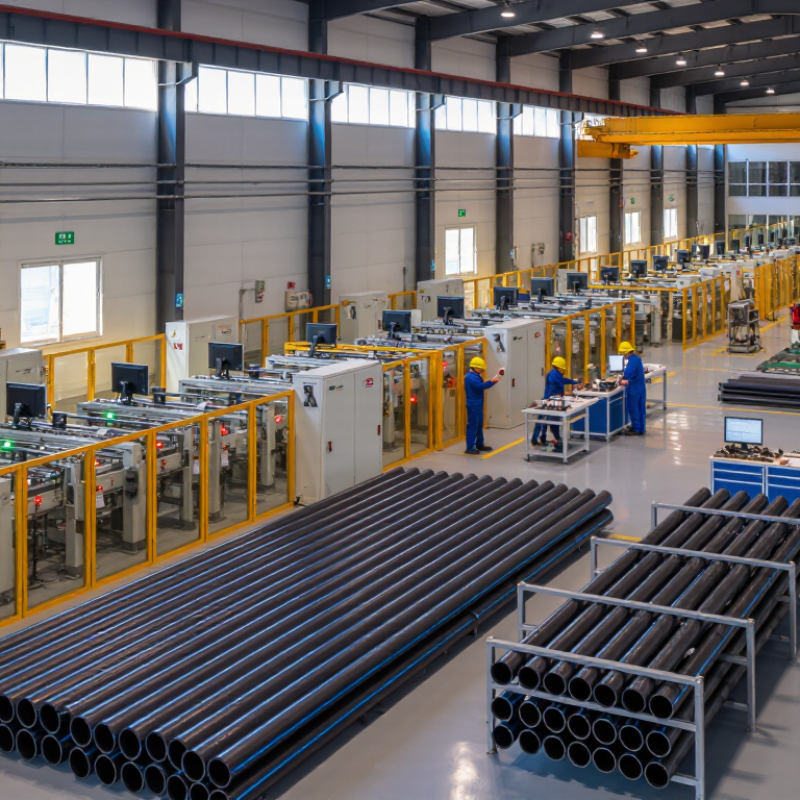
Reliable factories usually control the full production process. Technicians monitor melt temperature, extrusion speed, wall thickness, and ovality during manufacturing. Samples may undergo hydrostatic pressure, tensile, impact, and heat-reversion tests.
A practical detail matters here: clean storage prevents scratches and contamination before installation. Skilled welding teams also inspect butt-fusion joints, because poor alignment can weaken an otherwise excellent pipe.
Factory visits can reveal useful evidence. Look for calibrated laboratory equipment, marked production batches, and clear inspection procedures. Ask for recent test reports, not only brochures. Some suppliers offer competitive prices but provide limited long-term data. That deserves caution. No factory is flawless. Delays, inconsistent documentation, or weak after-sales support can still appear in a capable operation. The strongest manufacturers respond openly, correct defects, and adapt specifications to local soil, temperature, pressure, and installation conditions. Experience on the ground often matters more than impressive machinery.
The top HDPE pipe manufacturer should pass more than a price comparison. In practical procurement reviews, resin traceability is a strong starting point. A reliable factory should identify resin grade, melt-flow rate, production batch, and supplier records. Grand View Research valued the global HDPE market at about USD 78 billion in 2023. That scale increases the need for consistent material control, not impressive brochures.
Testing capability matters just as much. Ask for pressure-test records, dimensional reports, butt-fusion procedures, and independent laboratory results. ISO 4427 specifies requirements for polyethylene pipes used in water supply systems. ASTM F714 also covers polyethylene pipe dimensions and pressure classifications. A serious manufacturer should explain how its products meet these standards. Vague certificates are a warning sign.
Production depth reveals more than factory size. Inspect extrusion lines, cooling tanks, online measurement systems, and sample retention practices. The Plastics Pipe Institute notes that installation quality strongly affects long-term pipe performance. Therefore, technical support should include jointing guidance and site training. A five-year warranty sounds useful, but its exclusions need careful reading. One weakness remains: many buyers judge quality from polished samples alone. That approach can miss batch variation, delayed testing, or weak after-sales response. A factory visit, audit trail, and recent project references provide stronger evidence.
China has a large and competitive HDPE pipe manufacturing sector. Leading HDPE pipe manufacturers in China are not defined by factory size alone. They should show stable melt-flow control, certified pressure ratings, and complete resin traceability.
MarketsandMarkets estimated the global HDPE pipes market at about USD 22.4 billion in 2023. It also projected growth to nearly USD 30.4 billion by 2028. This demand raises production standards, but it also creates confusion. A polished website proves little. Buyers should inspect ISO 4427 compliance, GB/T 13663 testing, butt-fusion procedures, and independent laboratory records. Wall thickness matters. So does ovality after transportation. Small defects can become costly underground failures.
Tips
Request recent test reports, resin batch records, and project references. Ask how the manufacturer controls cooling, storage, and electrofusion surfaces. A serious supplier should explain pressure class selection in clear language. Avoid vague claims about “top quality.” They are not evidence. Site audits remain useful, although even audits cannot predict every future problem. That is an uncomfortable limitation.
The strongest suppliers usually combine modern extrusion lines with experienced technicians and responsive technical support. Check production capacity against your delivery schedule. Examine packing methods for long-distance shipping. Review warranty terms carefully, especially exclusions. Price should be compared with service life, not only purchase cost. No ranking is permanently correct; performance depends on application, standards, and quality control.
Selecting the top HDPE pipe manufacturer in China requires more than comparing prices or factory size. Grand View Research valued the global HDPE pipes market at about USD 19 billion in 2023, showing intense competition and rising demand. Yet production scale does not guarantee dependable quality.
A credible manufacturer should work to ISO 4427 for water systems and EN 12201 where European specifications apply. ASTM D3035 may also support dimensional and pressure requirements. Quality control should include melt-flow testing, density checks, wall-thickness measurement, and hydrostatic pressure tests. Each batch needs traceable resin records and inspection results. ISO/IEC 17025-accredited laboratories add stronger evidence, although certificates alone cannot replace factory audits.
Production capability matters in daily operation. Look for controlled extrusion lines, calibrated gauges, stable cooling tanks, and documented process settings. The Plastic Pipe Institute reports that properly designed polyethylene pressure pipe can provide a service life of 50 to 100 years under suitable conditions. That figure depends heavily on installation, temperature, pressure, and joint quality. A factory claiming unlimited performance deserves skepticism. I would also inspect sample cut sections, check ovality after storage, and review failure records honestly. No plant is flawless. The stronger manufacturers show how they detect and correct defects.
The best Chinese HDPE pipe manufacturer is not always the cheapest. Selection should begin with project requirements, not catalog promises. According to ISO 4427, pressure pipes require controlled dimensions, material performance, and documented testing. Ask for resin grade, MFR values, pressure ratings, and batch traceability. Vague answers deserve caution.
Production capacity also needs verification. Request recent factory audit records, laboratory calibration certificates, and sample test reports. The Plastics Pipe Institute identifies fusion quality, temperature control, and operator training as critical factors in polyethylene pipe systems. Check whether technicians follow written procedures for butt fusion and electrofusion. Watch a real production shift, if possible. Photos are not enough.
Independent data can support market research. Grand View Research has reported continued global growth in the HDPE pipes market, with infrastructure investment driving demand through the decade. Growth attracts capable suppliers and careless traders. That is the uncomfortable part. A polished website proves little. Compare wall thickness, ovality, impact strength, and hydrostatic test results across samples. Confirm whether testing follows ISO, ASTM, or project-specific requirements. Review export packaging, loading methods, and warranty language before signing. I would also request references from similar climates and pressure classes. A supplier may pass laboratory tests yet struggle with field communication. Leave room for that possibility.

Sign up for our mailing list to stay informed and up to date with our latest news and products!
(905) 832 – 0600
2175-A Teston Road
Maple, Ontario
L6A 1T3
(780) 451 – 0238
24790 – 117 Avenue
Acheson, Alberta
T7X 6C2
(604) 882 – 1564
9511 – 194A Street
Surrey, British Columbia
V4N 4G4
(306) 955 – 6005
3926 Arthur Rose Avenue Saskatoon, Saskatchewan
S7P 0C9
(450) 687 – 2721
2750 Rue Bernard-Lefebvre
Laval, Quebec
H7C 0A5